


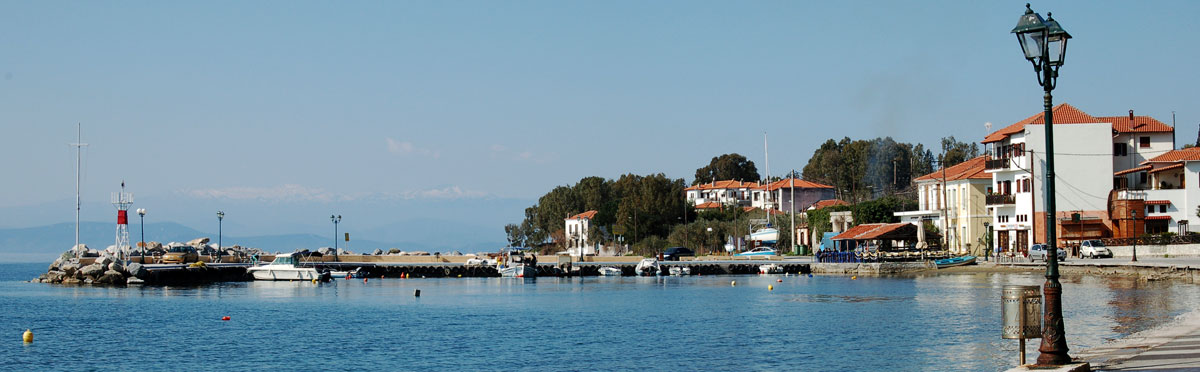
Kato Gatzea fishing harbour
The western slopes of Mount Pelion, descending gently toward the sheltered waters of the Pagasitikos Gulf, form one of the most historically layered landscapes in Thessaly. Among its most characteristic settlements are Ano and Kato Gatzea, together with the nearby villages of Vizitsa and Milies — a cluster where myth, rural tradition, monastic life, 18th–19th-century prosperity, and early engineering innovation all left indelible traces. Though today these villages appear serene and picturesque, their past reveals a dynamic region shaped by agriculture, trade, craftsmanship, education and, most famously, by one of Greece’s iconic narrow-gauge railways.
Ancient Roots and the Pelion Landscape
Although Ano and Kato Gatzea are not associated with major ancient cities, the broader Pelion area was deeply woven into Thessaly’s early identity. Myth situates the Centaurs on the mountain’s wooded slopes, while the wise Chiron — tutor of heroes such as Achilles and Jason — was believed to dwell in Pelion’s caves. These stories, echoing through classical literature, preserved a cultural memory of Pelion as a place of training, herbal knowledge, and rugged virtue.
The region’s superb climate, abundant springs, and fertile terraces supported continuous settlement from antiquity. Small farming communities and coastal hamlets formed along the gulf, supplying grain, fruit, and timber to the wider Thessalian plain. The coastal strip where Kato Gatzea stands today offered natural landing points for fishing and local transport, long before organised villages existed.
Ottoman Period: Formation of the Villages
Most Pelion villages, including Milies and Vizitsa, took their historical shape during the Ottoman era (15th–19th centuries). Pelion enjoyed a relatively privileged status within the empire, allowing its communities to develop strong local economies and self-governed structures.
Milies, in particular, rose as a cultural centre by the 17th and 18th centuries. Wealthy merchants and scholars who travelled to Central Europe, Egypt, and the Black Sea brought back both capital and education. Schools were established, churches were decorated with sophisticated iconography, and the village became known for its intellectual life.
Vizitsa developed as a prosperous agrarian settlement, famous for its impressive three-storey stone mansions (archontika). Their scale reflects the wealth generated by trade in olives, fruits, silkworms, and woodcraft. The village’s architecture is so intact that Vizitsa is today a preserved settlement of exceptional importance.
Higher up the slope, Ano Gatzea was shaped by olive groves, terraced fields, small manor houses, and monastic land holdings. Its position overlooking the gulf made it a strategic rural community, less exposed to piracy than coastal hamlets yet close enough to participate in maritime trade.
Kato Gatzea, by contrast, remained a small coastal outpost used primarily for fishing, boat maintenance, and the shipping of agricultural products. It served as the natural seaward extension of the upland villages.
Eighteenth–Nineteenth Century Prosperity
The 18th and early 19th centuries were the high point of Pelion’s economic development. The villages thrived on a mixed economy of olive oil, fruit cultivation, silkworm breeding, timber, and craftsmanship. Milies produced scholars and teachers, while Vizitsa produced merchant families who traded as far as the Danube and the Eastern Mediterranean.
Agricultural terraces were expanded, cobbled paths (kalderimia) were constructed to link the villages with each other and with the gulf, and many of the surviving mansions date to this period. The area’s population grew and cultural life flourished, creating the architectural and social landscape that still defines this part of Pelion.
The Pelion Railway: A New Era Begins (1892–1903)
The most transformative chapter arrived at the turn of the 20th century with the construction of the Volos–Pelion railway, designed by Italian engineer Evaristo de Chirico, father of the famed painter Giorgio de Chirico. Between 1892 and 1903 the narrow-gauge line climbed from the coast into the mountain, passing directly through Ano Gatzea, crossing stone bridges and tunnels, and terminating in Milies.
For the first time, agricultural goods could reach Volos rapidly, and villagers could travel more easily than ever before. The railway stimulated trade, improved access to markets, encouraged the growth of Kato Gatzea as a waterfront station point, and accelerated the cultural exchange already present in Milies.
Architecturally, the stations, bridges, retaining walls, and the famous De Chirico bridge near Milies introduced a new aesthetic: a fusion of Pelion stonework with European engineering. Many of these structures survive and form one of the most distinctive industrial heritage sites in Greece.
Twentieth Century: Decline, Migration, and Cultural Renewal
The 20th century brought profound changes. The Balkan Wars, World War I, and economic shifts weakened the rural economy. Many families migrated to Volos, Athens, or abroad, and the Pelion railway saw a gradual decline as roads became dominant.
Yet the villages endured. Milies revived its cultural legacy with schools, libraries, and museums. Vizitsa was preserved rather than abandoned, its mansions restored in the late 20th century. Ano Gatzea transformed its rural heritage into cultural infrastructure, including the conversion of a 1924 stone house into the Olive and Olive Oil Museum.
Tourism emerged slowly after the 1970s. The combination of architecture, nature, and railway nostalgia brought visitors, and the “Moutzouris” steam train — partially revived for heritage rides — became a symbol of Pelion’s modern identity.
Sightseeing
1. Ano Gatzea
- Olive and Olive Oil Museum: beautifully restored 1924 mansion with exhibits on local production.
- Railway Station & Tunnel: part of the Pelion line; a perfect spot to understand the engineering that connected the mountain to Volos.
- Monastery of Agia Triada: built on the remains of a Venetian fortification; panoramic views over the gulf.
2. Kato Gatzea
- Waterfront Promenade: calm coastline with fishing boats and walkways.
- Old Olive Warehouses: reminders of the coastal export economy.
- Small Beaches: ideal for swimming, with easy access to cafés and tavernas.
3. Vizitsa
- Stone Mansions (Archontika): preserved 18th–19th-century noble houses, showcasing Pelion’s architectural peak.
- Central Square and Fountain: focal point shaded by plane trees.
- Traditional Kalderimia: pathways connecting Vizitsa with Milies and other villages.
4. Milies
- Pelion Railway Terminus: station, stone bridge, and the De Chirico arch — icons of Pelion’s industrial heritage.
- Church of the Archangels (Taxiarches): featuring remarkable 18th-century frescoes.
- Folklore Museum & Historic Library: repositories of local education and craftsmanship.
- Kalderimi to Vizitsa: one of Pelion’s most scenic traditional walking routes.
5. Moutzouris
The Pelion Railway — often called “Moutzouris” (the “little train of Pelion”) — is still operational, now as a heritage/tourist railway. It runs between Ano Lechonia (on the coast) → through Ano Gatzea → and up to Milies (in Pelion’s mountains). During the main season (spring to autumn) the train runs weekends (Saturday & Sunday), with a morning departure (~ 10:00) from Ano Lechonia and return from Milies (~ 15:00). In summer months (July–August) service may be more frequent. There is a 15-minute stop at Ano Gatzea in both directions — which makes it easy to break the journey there.
The ride is a 15-kilometre scenic journey lasting about 90 minutes, winding through wooded slopes of Pelion, crossing old stone bridges, tunnels, and culminating at the mountain village of Milies. For a memorable experience: book your ticket in advance (often fills up fast), depart from Ano Lechonia early morning, enjoy the 15-minute stop at Ano Gatzea, then disembark at Milies to explore its historic alleys, have lunch under plane trees, and maybe return the same day or stay overnight.
More info here
Flavours
The villages share the gastronomy of western Pelion:
- Olive oil of exceptional quality, used in pies, vegetables, and local pastries.
- Tsipouro with meze, including grilled octopus, small fish, spetsofai, local cheeses, and mountain herbs.
- Fruits of Pelion — apples, chestnuts, quinces — inspiring spoon sweets and autumn dishes.
- Village tavernas often combine seafood from Pagasitikos with mountain produce, creating a unique sea-and-slope cuisine.


