


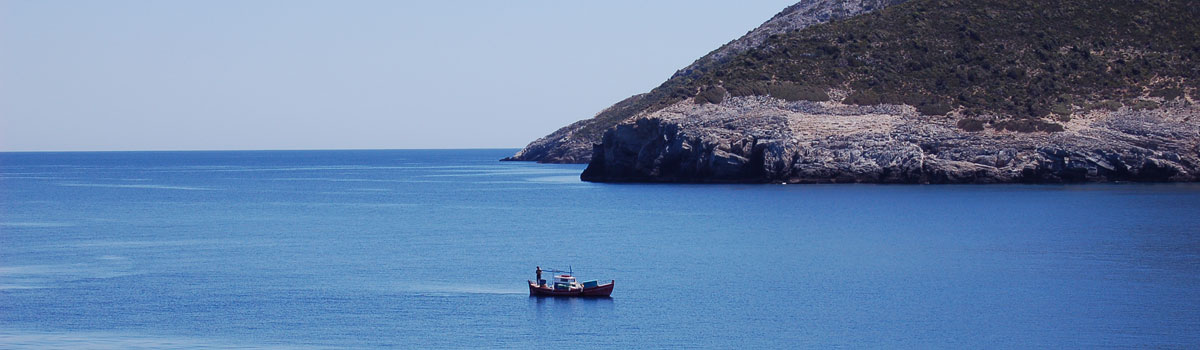
Returning to port
Prehistoric Beginnings
Alonnisos enters the historical landscape surprisingly early. Although the most famous Mesolithic sites lie on neighbouring islets, the main island shows signs of prehistoric activity from the Neolithic onward. Small-scale surveys across the south and southeast coastlines—particularly above Megalos Mourtias, Vrysitsa and near Kokkinokastro—have yielded stone tools and pottery fragments suggesting scattered habitation or seasonal use. These early groups were likely fishermen and foragers moving through the Northern Sporades, exploiting its rich marine life and sheltered coves.
By the Late Neolithic and Early Bronze Age (c. 3000–2000 BC), the island participated modestly in the wider Aegean maritime world. While no large settlements have yet been uncovered, ceramics and lithic finds indicate that Alonnisos was not isolated: it formed part of a chain of stepping-stone islands linking mainland Thessaly with the Cycladic sphere.
The Classical Island of Ikos
In antiquity, the island was known as Ikos, a name linked to both legend and viticulture. Classical writers—especially Strabo—praise Ikos for its fine wines, which were traded across the Aegean. Amphorae stamped with local marks, found in shipwrecks and coastal sites, confirm an active wine-export economy from at least the 5th century BC.
The political life of Ikos was typical of a small Sporadic polis: modest in power but well integrated into maritime networks. The main ancient settlement is associated with the area of Kokkinokastro, a headland that preserves traces of fortification walls, building foundations and a coastal cemetery. These indicate a community organised enough to defend its position and to bury its dead with durable markers.
During the Classical and Hellenistic periods, Ikos navigated the shifting alliances of the northern Aegean. Its strategic location between Skiathos and Skopelos placed it along sea routes that mattered both to Athens and to Macedon. While rarely mentioned in great political events, Ikos benefitted from maritime commerce and relative autonomy.
Roman and Early Christian Periods
Under Roman rule, Ikos continued its role as a minor but stable island economy. Trade persisted, especially in wine and agricultural products, and villa-style rural dwellings likely appeared in sheltered valleys. The island’s protected bays made it a modest stop for coastal transport between Thessaly, the Sporades and Asia Minor.
The spread of Christianity in the 4th–6th centuries AD is attested mostly indirectly. No large basilicas have yet been fully documented on the island, but pottery, burial types and fragmentary architectural remains around Old Village and southern coastal terraces hint at small rural Christian communities. The island’s remoteness probably kept Christianisation gradual but peaceful.
Byzantine Era & the Age of Piracy
From the Middle Byzantine era onward, Alonnisos’ history becomes inseparable from the story of piracy in the Northern Sporades. The island’s elongated shape, deep coves and proximity to key sea lanes made it attractive to raiders and vulnerable to attack.
By the 9th–10th centuries AD, the population shifted inland to more defensible heights, culminating in the development of the Old Village (Chora) on its commanding hilltop. Here, narrow lanes and clustered stone houses formed a defensive labyrinth, evolving into a fortified settlement capable of withstanding incursions.
The island suffered repeated attacks during periods of instability—especially as Arab, Latin and later Ottoman corsairs roamed the Aegean. Yet despite these pressures, Alonnisos remained inhabited, sustained by subsistence agriculture, viticulture and limited trade.
Venetian–Ottoman Rivalries (14th–16th Centuries)
The Northern Sporades became contested ground between Venice and the rising Ottoman Empire. Although not as heavily fortified as Skiathos or Skopelos, Alonnisos’ location placed it in the path of fleets and corsairs.
The most devastating episode occurred in 1538, when Hayreddin Barbarossa, in the service of the Ottomans, swept through the Sporades. Alonnisos, like many islands in the region, was raided—its settlements damaged, population reduced and economy disrupted. The trauma of this attack remained part of local memory for centuries.
Ottoman Rule (16th–19th Centuries)
Under long Ottoman administration, Alonnisos experienced alternating phases of decline and recovery. The island never became a major administrative centre, but it maintained a rural life shaped by:
- Agriculture: olives, vines, almonds
- Pastoralism: goats and sheep on terraced slopes
- Fishing: the most dependable resource, including early tuna and anchovy fisheries
- Seafaring: small caiques linked Alonnisos to Skopelos and mainland ports
Piracy persisted well into the 17th and even 18th centuries, keeping the Chora strategically vital. Despite hardships, population slowly grew, and by the early 19th century the island hosted stable family communities tied by kinship and maritime trade.
The Greek War of Independence & 19th-Century Shifts
During the 1821 Revolution, the Sporades played important roles as supply and naval support bases. Alonnisos did not host major battles, but its coves sheltered merchant and naval vessels involved in the conflict. After independence, the island experienced administrative reorganisation—this is when the name “Alonnisos” was transferred to the modern island, reversing the ancient naming, which had applied “Alonisos” to Kyra Panagia.
Throughout the 19th century, population pressures, limited agricultural land and economic hardship produced waves of emigration. Some families left for Skiathos, Skopelos or the mainland; others joined the expanding merchant-mariner communities of the Aegean.
Early 20th Century – Subsistence, Migration & the Sea
The early 1900s on Alonnisos were characterised by poverty but strong communal bonds. People relied on terrace farming, olive groves, and above all the sea. Women managed agricultural work while men often sailed seasonally.
Italian occupation during World War II, followed by German control in parts of the Sporades, affected supplies and increased hardship. Alonnisos did not witness large battles, but the occupation left economic strain and occasional conflict with occupying forces.
The 1965 Earthquake – Abandonment & Rebirth
The defining moment of modern Alonnisos came on 9 March 1965, when a major 6.3-magnitude earthquake devastated the island.
- Houses in Chora collapsed or became uninhabitable.
- Infrastructure was destroyed.
- The population was forced to relocate.
Most residents abandoned the ruined hilltop and moved to the sheltered harbour of Patitiri, which quickly grew into the new administrative and commercial centre. The Old Village remained largely deserted for two decades.
In the 1980s–90s, foreign and Athenian buyers began restoring abandoned houses, slowly bringing Chora back to life. Today, it retains a medieval atmosphere shaped both by authentic remnants and careful reconstruction.
Late 20th Century to Today – Marine Park, Conservation & Tourism
From the 1990s onward, Alonnisos shifted toward sustainable tourism. The creation of the National Marine Park of Alonnisos and Northern Sporades, centred around the protection of the Mediterranean monk seal (Monachus monachus), gave the island an international conservation identity.
The modern economy blends tourism with fishing, boutique agriculture, small wineries, and local crafts. Alonnisos today markets itself as the quiet, authentic Sporades island—deeply traditional yet shaped by one of the most dramatic modern transformations in the Aegean.
Kokkinokastro – The Ancient Citadel of Ikos
Kokkinokastro is the most historically potent landscape on modern Alonnisos. The headland’s red cliffs rise sharply from the sea, forming a natural acropolis that explains why ancient Ikos chose this point for its main settlement. Archaeology confirms a sequence of habitation layers: prehistoric activity on the surrounding terraces, Classical-era fortification walls, building foundations and graves, and submerged ruins at the base of the cape that hint at shoreline change over millennia.
The Classical city appears to have extended across the plateau above the cliffs. Pottery dating from the 5th–4th centuries BC, including storage amphorae and domestic ware, points to an active, self-sustaining community. The position offered control over the maritime routes between Thessaly, Chalkidiki and the central Aegean — a critical advantage in the era when Ikos’ wine began to circulate widely.
Kokkinokastro’s coastline preserves sections of an ancient cemetery whose tombs, now partly eroded or submerged, align with broader Greek funerary practices of the period. Underwater archaeologists have mapped walls and structural remains just offshore, suggesting that a coastal quarter or harbour installations once stood here before gradual subsidence carried them beneath the sea.
Chora (Old Village) – Fortress, Refuge and Rebirth
The Old Village, perched high on the spine of Alonnisos, is the island’s historical heart. Its origins lie in the Middle Byzantine and early medieval centuries, when piracy and insecurity pushed populations across the Northern Sporades to fortified hilltops. The settlement developed around a nucleus of defensive walls and strategically clustered houses; narrow lanes twisted between stone structures to slow attackers and shield inhabitants from sudden raids.
Through the Venetian and Ottoman centuries, Chora was the island’s stronghold and its cultural centre. Small churches, rebuilt over older foundations, reflect a continuity of worship even during periods of hardship. Families cultivated terraces around the hill, tended olives, and kept flocks while maintaining a vigilant relationship with the sea that sustained and threatened them in equal measure.
The disaster of the 1965 earthquake abruptly ended centuries of continuity. Much of Chora became uninhabitable overnight, and the population relocated to Patitiri. For years, the Old Village stood silent — a shell of ruins overlooking the Aegean.
Then came its unexpected second life. Beginning in the late 20th century, restoration efforts revived the settlement house by house. Craftsmen rebuilt collapsed walls, maintaining traditional forms while adapting interiors to modern living. Today, Chora stands as a living monument: medieval in layout, restored in spirit, offering atmospheric lanes, viewpoints and small cafés where the archaeology of daily life is still visible beneath the plaster.
Patitiri – Harbour, Refuge and the Modern Face of Alonnisos
Patitiri, named after the old grape-pressing floors once scattered across its slopes, is modern Alonnisos’ entry point and administrative capital. Before the 20th century it functioned only as a working harbour supporting Chora: a place for fishing boats, cargo, and the seasonal movement of goods.
Everything changed in 1965. When the earthquake destroyed the Old Village, Patitiri became the natural refuge. Tents, temporary shelters and hastily built houses formed the nucleus of a new town. Over the next decades, Patitiri expanded linearly along the coastline and climbed the hills, evolving into a vibrant harbour with shops, tavernas and the island’s main services.
Despite its modern appearance, Patitiri retains links to older rhythms. Fishing caiques still anchor beside excursion boats, local warehouses echo the trade in wine and olives, and the sheltered bay continues to shape daily life. The town also hosts the Museum of Traditional Culture, which helps visitors understand the material history that shaped Alonnisos long before tourism arrived.
Today Patitiri is the island’s beating heart — practical, lived-in, and framed by steep green hills that remind travellers how recently this settlement emerged from the upheaval of disaster.
Sightseeing
Historic & Archaeological
- Kokkinokastro: Walk the ridge for views of the ancient city’s footprint, eroded tombs and offshore submerged remains.
- Chora (Old Village): Explore the restored medieval lanes, small churches, and surviving architectural fragments from earlier periods.
- Museum of Traditional Culture (Patitiri): Displays old tools, household items, fishing equipment, war memorabilia and local craft traditions.
Nature & Scenic Points
- National Marine Park – Land Zone: Trails near Gerakas and the southern coastline offer views into the marine conservation area.
- Megalos Mourtias & Vithisma viewpoints: Historic terrace landscapes with sweeping sea vistas.
- Byzantine chapels around Chora: Small rural shrines marking centuries-old religious routes.
Beaches & Coastal Highlights
- Chrisi Milia: A sheltered bay with classical-era ceramics occasionally found in older surveys.
- Leftos Gialos: Emerald waters framed by pine-covered slopes—no major history but iconic scenery.
- Glyfa & Rousoum Gialos: Traditional fishing zones close to Patitiri.
Walking & Heritage Landscapes
- Old paths from Chora to Patitiri and to coastal settlements: Trace the pre-1965 routes used for centuries.
- Terraced agricultural landscapes: Stone terraces near Vrysitsa and Isomata reveal older subsistence practices.
Flavours
Local Dishes
- Alonnisos tuna: Traditionally cured or preserved, reflecting the island’s deep fishing heritage.
- “Alonisiotiki tyropita”: A spiral cheese pie baked in a pan, crisp and rustic.
- Goat with herbs: Slow-cooked dishes using wild island thyme, oregano and sage.
- Fresh anchovies & small fish: The backbone of local cuisine, grilled or marinated.
Products & Traditions
- Local honey: Produced from thyme and pine, characteristic of the Sporades.
- Herbal infusions: Reflecting Alonnisos’ long tradition with medicinal plants.
- Olive oil & almonds: staples of the island’s agricultural identity.
Tavernas & Food Culture
Expect cooking strongly linked to provenance: fresh catch brought straight into Patitiri, small family kitchens preserving old recipes, and seasonal ingredients guiding menus. Food on Alonnisos is less commercial than on its sister islands — simple, local, and shaped by the sea.

