


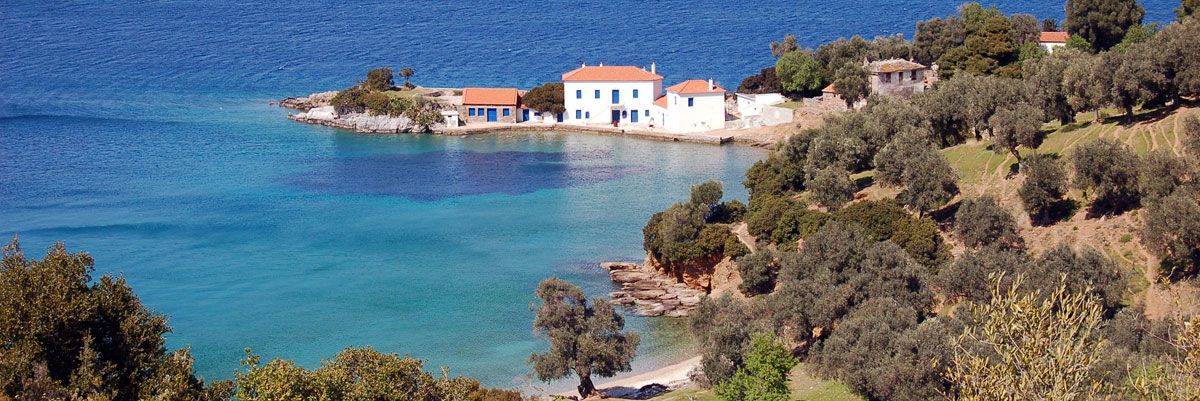
Idyllic cove
The inland plateau of Argalasti and the coastal curve of Milina belong to one of the most culturally layered landscapes of Pelion. Archaeological traces around Argalasti indicate habitation as early as the 11th–10th century BC, with small rural settlements tied to the fertile interior valleys. The gentle slopes, abundant springs, and sheltered coves formed a natural corridor between the Pagasitikos Gulf and the mountainous interior, allowing early communities to sustain agriculture, pastoral life, and coastal exchange.
Milina’s coastline forms the southern edge of the ancient territory of Olizon, a city firmly positioned in the mytho-historic world of early Greece. Although Milina itself is a modern village, its surrounding ridges and inlets have been inhabited, sailed, and traversed for over three millennia.
Homeric Olizon and the World of Philoctetes
The most powerful anchor of early history in this region is the Homeric city of Olizon, identified with the fortified height of Palaiokastro (Vigla) just east of Milina. In the Iliad, Olizon appears in the Catalogue of Ships as the homeland of Philoctetes, the archer-king whose poisoned arrows were essential to the fall of Troy. From these shores, Homer tells us, Philoctetes launched his ships toward Asia Minor, binding the area forever into the legendary fabric of the Trojan cycle.
Archaeology supports a flourishing settlement here during the 6th–3rd centuries BC, strategically positioned to oversee maritime routes across the Pagasitikos. Its acropolis commanded the passage between the inner gulf, the open Aegean, and the southern Pelion coast—an enviable location for a city-state whose prosperity was tied to navigation and coastal agriculture.
Classical to Hellenistic Activity
Throughout the Classical and Hellenistic periods, Olizon maintained its role as a maritime and agricultural centre. Pottery sherds, architectural fragments, and harbour indicators around modern Milina and its offshore islets suggest a network of coastal installations. The calm waters of the inner gulf served as both refuge and highway, enabling trade with the Thessalian plains, the Northern Sporades, and the Magnesian hinterland.
During the 4th and 3rd centuries BC, when the political landscape of Thessaly shifted between Macedonian, local, and federal control, Olizon appears as one of the numerous fortified nodes supporting communication across Pelion. Although never a dominant polis, it functioned as a stable regional port.
Roman and Early Christian Period
Under Roman administration, the region entered a more peaceful and connected era. Roads and maritime routes were stabilised, and agriculture intensified. The discovery of Early Christian basilica remains near the coastal zone between Milina and Valtoudi shows that by the 5th–6th centuries AD, a Christian community flourished here, inheriting both the settlement footprint and the maritime orientation of earlier centuries.
The coastal anchors continued to serve fishermen, small-scale traders, and travelling clergy. Many of the Byzantine and post-Byzantine pathways that connect Milina with Lafkos and Argalasti likely follow earlier Roman or even Classical routes.
Byzantine and Medieval Continuity
By the Middle Byzantine period, habitation persisted in smaller clusters. The coastline was dotted with monastic dependencies, most prominently on the islets of Alatas and Prasouda, which hosted Byzantine monasteries whose ruins still survive. These monastic outposts served as spiritual refuges, agricultural holdings, and points of maritime control. Their presence suggests that the area retained importance as a sheltered crossing point for monks, merchants, and fishermen.
Toponyms such as Milina, probably of Slavic origin (mlýn—mill), point to renewed settlement activity during the early medieval centuries, when Slavic groups moved into Thessaly but ultimately integrated with local Greek populations.
The Ottoman Era and Village Development
From the 15th century onward, Argalasti emerged as an inland centre of Pelion. Protected from coastal raids yet close enough to the sea to maintain trade, it developed strong agricultural production—grain, olives, fruits, and notably sericulture. By the 18th century, its prosperity was evident in large stone mansions, ecclesiastical structures, and organized estates. Argalasti became a regional node for tax collection, trade routes, and ecclesiastical administration.
Milina, by contrast, remained a modest coastal settlement until later. Its maritime life was shaped by shipbuilding, fishing, and sponge-diving, crafts that gained momentum in the 18th and 19th centuries. Families from Lafkos and Argalasti often expanded toward the coast seasonally, using the sheltered bays for small shipyards and fishing stations.
Revolution and the Birth of Modern Communities
During the Greek War of Independence (1821), Argalasti played a background role as part of the wider Pelion revolts. After the incorporation of Thessaly into the Greek state in 1881, Argalasti became the administrative centre of South Pelion, seat of local government and infrastructure. Its stone architecture—especially the churches and bell towers—reflects this late 19th- and early 20th-century civic confidence.
Milina, meanwhile, transformed from a seasonal coastal outpost into a permanent village, shaped by seafarers, fishermen, and craftsmen. The calm waters between Milina and the nearby islets became a lively microcosm of small-scale maritime economy.
20th Century to Today
By the early 20th century, Argalasti functioned as a well-connected rural hub with schools, markets, and municipal services. Milina emerged as a picturesque coastal settlement, first serving local fishermen and later attracting visitors drawn by its sunsets, gentle shoreline, and island-dotted views.
Post-war improvements in transportation and the advent of tourism strengthened Milina’s identity as a seaside community, while Argalasti remained the cultural and administrative heart of South Pelion. Together, the two villages represent the dual character of southern Pelion: inland tradition balanced with coastal life, agriculture intertwined with the sea, and ancient memory woven into everyday rhythms.
Sightseeing
Argalasti
- Church of Agioi Apostoloi (Saints Peter & Paul) – (1886, bell tower 1913). A masterpiece of Pelion stonework with fine marble elements.
- Church of Agios Nikolaos – Built over a Byzantine predecessor; elegant Pelion architecture.
- Traditional stone mansions – Evidence of 18th–19th century prosperity, many with carved portals and courtyards.
- Argalasti Square – The social core of the village, ideal for exploring local cafés and neoclassical façades.
- Trails toward Lafkos and Xinovrysi – Old pathways through orchards, olive groves, and gentle terraces.
Milina & Coastal Zone
- Ruins of Ancient Olizon (Palaiokastro/Vigla) – A hilltop with views over the gulf; scattered architectural fragments from the ancient acropolis.
- Islet of Alatas – With remnants of the Byzantine monastery of the Forty Saints; serene and atmospheric.
- Islet of Prasouda – Ruins of the monastery of Zoodochos Pigi; a quiet landmark visible from Milina’s seafront.
- Early Christian basilica site – Near the coastal line; low foundations and stone remnants indicate a 5th–6th-century community.
- Milina waterfront – A long, calm strand ideal for walking, with views toward the islets and sunset.
Wider Walks & Short Excursions
- Lafkos – One of the most beautiful Pelion villages, with stone alleys and artistic heritage.
- Chondri Ammos – Coastal area connected to the ancient territory of Olizon.
- Olive-grove paths – Between Argalasti, Milina, and Lafkos, offering shaded rural scenery.
Flavours
- Olive culture is central: the plateau around Argalasti produces fine olive oil with a mellow, fruity profile.
- Local orchard fruit—figs, apples, pears—reflect the microclimate that favoured agriculture since antiquity.
- Tsipouro tradition carries the warmth of South Pelion hospitality, often accompanied by small meze plates.
- Sea flavours dominate Milina: fresh fish, simple grilled dishes, and the quiet ritual of seaside meals.


