


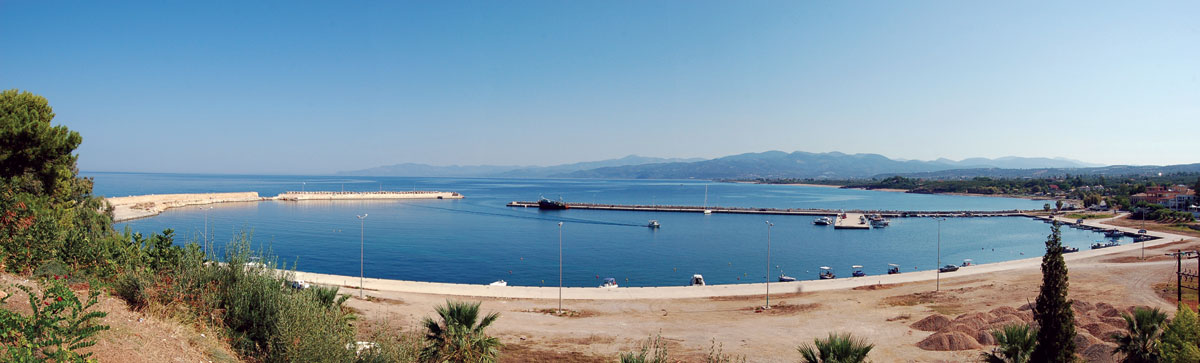
Kyparissia harbour
Kyparissia, seated upon the western Peloponnesian coast where the green slopes of Mount Aigaleo meet the Ionian Sea, has always stood as a threshold between land and water, past and present. Its history is as layered as the stone terraces that climb from its port to the castle crowning its old town — a history stretching from the mists of Homeric legend to the turbulent centuries of empire and liberation.
Antiquity – The Homeric City of Kyparissos
The earliest known settlement at the site of modern Kyparissia was ancient Kyparissos, mentioned by Homer among the towns of King Nestor’s Pylian realm in the Iliad. Its name, derived from the cypress tree (kyparissos), hints at both the verdant landscape and a possibly sacred connotation: the cypress being a tree associated with mourning and immortality in Greek thought.
Archaeological traces point to continuous habitation since the Mycenaean period (14th–12th century BC). The fertile plain of Trifylia provided grain, olive oil, and livestock, while the proximity to the Ionian Sea encouraged maritime trade. The city’s location, roughly midway between Pylos and Olympia, made it an ideal coastal station in the network of western Peloponnesian commerce.
During the Classical and Hellenistic eras, Kyparissia remained a modest but thriving town under the influence of the Arcadians and Eleans, occasionally falling within the sphere of Spartan control. Coins of the period bear local symbols — often cypresses or dolphins — attesting to civic pride and maritime activity. It was also near the routes of athletes and pilgrims traveling toward Olympia, a connection that kept it within the orbit of Panhellenic life.
Roman and Early Christian Kyparissia
Under Roman rule (2nd century BC onward), Kyparissia was incorporated into the province of Achaia. The peace and infrastructural development brought by Rome benefited the region immensely: roads, baths, and a small harbor were built, linking it more effectively with Patra, Olympia, and Italy. Roman inscriptions and villa remains found in the area testify to local prosperity and Romanized elite families who maintained estates along the coast.
Christianity reached Kyparissia early, perhaps through sailors or merchants. By the 5th century AD, the town had become a bishopric — a sign of urban continuity even after the administrative collapse of the Western Empire. The ruins of early basilicas around the area of Mourtzinos and the lower town reveal a vibrant Christian community engaged in agricultural and coastal trade well into the Byzantine era.
Byzantine Fortress and Medieval Kyparissia
During Byzantine times, Kyparissia emerged as a fortified stronghold against pirate raids and Slavic incursions. The castle of Arcadia, as the medieval town was later known, stands as the enduring symbol of that epoch. The fortress — occupying the same acropolis as ancient Kyparissos — was originally built in the 6th century AD, possibly under Emperor Justinian, and repeatedly repaired through the centuries. Its position commands a sweeping view of the Trifylian plain and the Ionian horizon, a strategic advantage that made it an essential node in the Peloponnesian defense system.
The medieval name “Arcadia” gradually replaced Kyparissia, perhaps echoing the broader region or an administrative shift within the Byzantine themes. This Arcadia should not be confused with the inland Arcadia of the Peloponnesus; chroniclers and travelers often distinguished it as Arcadia by the Sea.
By the 12th century, the town flourished as a provincial center with its bishopric restored, a small garrison, and active trade via its port. Yet, its fortunes changed dramatically with the Frankish conquest following the Fourth Crusade (1204). The French lords of the Principality of Achaea recognized the strategic importance of Arcadia’s castle and fortified it further. They called it Arkadía de la Mar and installed knights and castellans who ruled over the fertile Trifylian countryside.
The castle’s form today still reflects this Frankish-Venetian synthesis — the polygonal walls, the round towers, and the vaulted interiors — all signatures of medieval Western engineering layered over Byzantine foundations.
Venetians, Ottomans, and the Struggle for the West Peloponnesus
The Venetians first seized Kyparissia in 1460, after the fall of the Despotate of the Morea, but soon yielded it to the advancing Ottomans. Under Ottoman administration, the town was renamed Arkadi or Arkadia, and served as the seat of a kaza (district). Despite the heavy taxation and periodic raids, life persisted: the port facilitated the export of olive oil, wine, and raisins, while artisans and traders kept the urban core alive.
The Venetians returned in 1686 during their second occupation of the Peloponnese (the “Kingdom of the Morea”) and undertook repairs of the castle and the port, emphasizing again Kyparissia’s maritime potential. Yet their control lasted only until 1715, when the Ottomans reconquered the region.
Through the 18th century, Kyparissia remained a lively provincial town of several thousand inhabitants, with Greek and Albanian-speaking populations coexisting under Ottoman rule. Its location on the Ionian coast made it an important link between the Morea and the Ionian Islands — and a haven for travelers, smugglers, and early patriots.
War of Independence and the Modern Town
The Greek Revolution of 1821 found Kyparissia ready. Local leaders and fighters from Trifylia quickly rose against Ottoman authority, participating in battles across Messenia. The old castle was briefly reoccupied by Greek rebels, and the Ottomans were expelled by 1825 — though not without suffering during Ibrahim Pasha’s devastating campaign through the Peloponnese.
After independence, the town regained its ancient name, Kyparissia, and entered a new era of reconstruction. By mid-19th century, it became the administrative center of the Trifylia province, with a neoclassical urban plan drawn below the medieval upper town. The port, reactivated for trade with Italy and the Ionian Islands, gave fresh impetus to agriculture and commerce.
The 20th century brought modernization — roads, railways, and education — but also hardship, as Kyparissia suffered population losses from emigration and the Second World War. Yet, through it all, the town’s charm endured: an amphitheater of stone houses cascading toward the sea, dominated by the silent sentinel of its Frankish-Byzantine castle.
