

Kýthnos island had different names over the centuries, each one with its own meaning. The name Kýthnos derived from the leader of the Drýopes, Kýthno, who initially conquered the island. In the 12th century AD the island was named Thermía, due to the thermal springs that still exist in the bay of Loutrá. The ancient name Dryopís derived from the fact that it was colonized by Drýopes. During the Frankish rule it was known as Fermína. Last, during antiquity the island was also named Ofioússa or Thiramniá.
Kýthnos was first inhabited between 9500 and 8500 BC., according to findings on the northeastern coasts of the island (four graves with signs of human presence from the Mesolithic Era).
The tribe of Drýopes came from the island of Évvoia and arrived at Kýthnos around the 12th to 11th century BC. Then came the Iones, with Késtora and Kélyfo as their leaders, who improved and reinforced the colony. Excavations on the beach of Episkopí up until Chóra (the capital of the island), brought to light rich findings from the ancient civilization.
In the Classic years, the island was known for its excellent organization and political system. It was actually mentioned in Aristotle’s book “Kýthnian State”, which unfortunately does not exist anymore.
During the Roman rule, Kýthnos was used as an exile for roman political prisoners.
From the 4th century AD up until the fall of the Byzantine Empire to the Franks (13th century AD), the island had the same fate with most of the Cyclades island. As the Byzantine Empire was practically unable to defend them, the pirates plundered for centuries and as a result, their resources and population kept thinning over the centuries.
For approximately 3 centuries, 13th to mid 16th century AD, Kýthnos was on the hands of the Venetians, up until the admiral of the Turks and King of All Pirates of the Mediterranean Barbaróssa (red beard), conquered the island, slaughtered whoever he could and sold the rest he could get his hands on to the slave markets of Asia. For unknown reason, in1600, the Turks killed all the male population of the island. As a result, the years following, the island was depopulated and gradually colonized by settlers from the nearby islands (one century later, the island numbered just over 1000 inhabitants).
Kýthnos was among the first islands to raise the flag of the Hellenic Revolution of 1821.
There was significant contribution to the arts and literature. The painters Timánthis (4th century BC.) and Kydías (1716 – 1786 AD) and the historian Agisídimos (1st century BC.) originated from Kýthnos.
There are several and beautiful churches and monasteries all around the island, for example Panagía Kanála, the monastery of Panagía Níkous, Panagía Stratilátissa and Panagía Flabourianí, with an amazing view to the pelago. The island is also filled with beautiful bays and sandy beaches, all in small distances between them.
Sights
Merichas
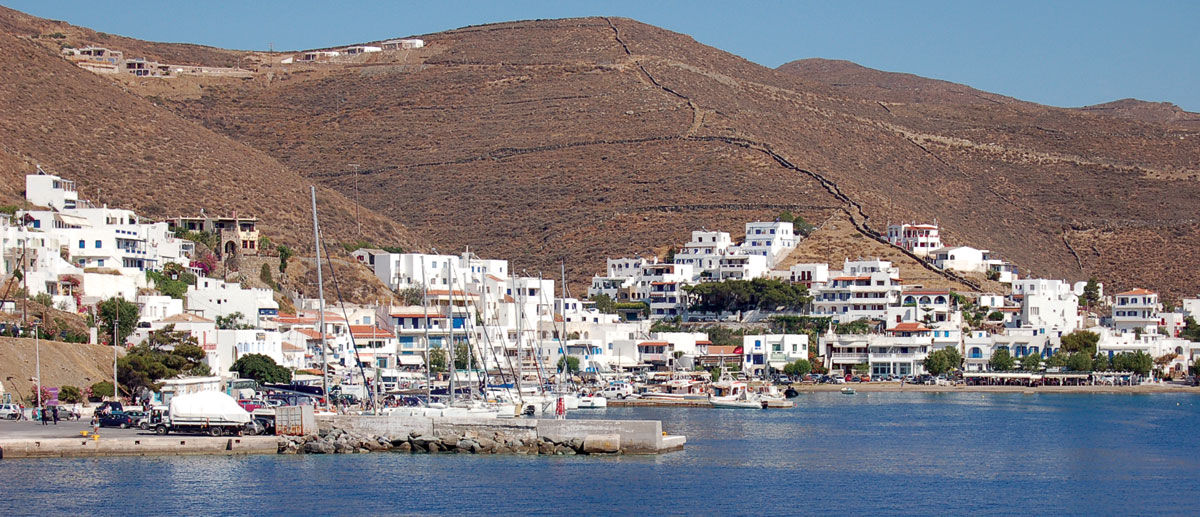
The main port of Kythnos offers a lively first impression of the island, combining practicality with a relaxed summer atmosphere. Nearby beaches and spectacular sunset views give the area a distinctive charm.
Loutra (Thermia)
Inhabited since antiquity due to fresh water and natural shelter, Loutra is famous for its thermal springs, known for their therapeutic properties since Byzantine times. The island’s former name, Thermia, reflects their importance.
Agios Stefanos
A small and peaceful seaside settlement with only a handful of residents. The surrounding coves provide quiet, almost private swimming spots in crystal-clear waters.
Kolona Beach
The most iconic beach of Kythnos, where a narrow strip of sand connects the island to a small islet, forming two bays. It is one of the most unique coastal landscapes in the Cyclades.
Chora (Messaria)
The island’s capital is a classic Cycladic settlement with whitewashed houses and narrow alleys. It preserves an authentic and unspoiled character.
Dryopida
A distinctive village with tiled roofs instead of the usual Cycladic flat roofs. Its traditional atmosphere and architecture make it one of the most interesting inland visits.
Katafiki Cave
One of the most important caves in the Cyclades, featuring impressive stalactites and stalagmites. It offers a different, underground perspective of the island.
Castle of Oria
The medieval capital of Kythnos, strategically positioned for defence against pirates. Though destroyed after a long siege, its ruins still reveal the strength and significance of the settlement.
Rigokastro
An ancient settlement that flourished in antiquity, offering insight into the island’s long and continuous history.
Panagia Kanala
One of the most important religious sites on the island, set in a beautiful pine-covered landscape by the sea. The church houses a revered icon of the Virgin Mary and plays a central role in the island’s spiritual and social life, especially during the major celebration on 15 August.
Monastery of Panagia Nikous
An important religious site that functioned as a secret school during Ottoman times. Its feast on 15 August is one of the island’s major celebrations.
Flavours
Traditional pies
Local pies stand out for their handmade pastry and rich fillings, forming a core element of everyday and festive cuisine.
Goat and festival meats
Roasted meats and festive dishes are central to local celebrations, especially during summer feasts, highlighting the island’s strong communal spirit.
Honey and simple sweets
Kythnos honey and traditional desserts express the island’s natural purity and simplicity, often served as a welcoming treat.
Honey and simple sweets
Kythnos honey and traditional desserts express the island’s natural purity and simplicity, often served as a welcoming treat.
Local wine
Produced in small quantities, local wine carries an authentic character and pairs perfectly with traditional dishes.
Festivals and food culture
Food on Kythnos is inseparable from its festivals, such as the Lazani carnival, where flavours, music and tradition come together in a lively communal experience.