


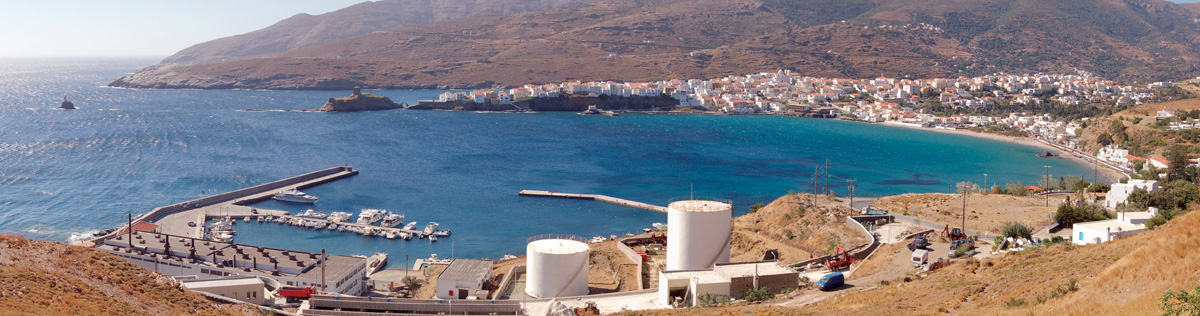
According to mythology, the island was named after Ándro, son of Ánios, who was a son to god Apollo. However, there is another theory, supported by the ancient Diódoros of Sicily, that the island was named after the general Ándro of King of Crete Radámanthy. Ándros was also known in antiquity as Ydroúsa, Lasía, Nonagría and Epagrís, all these names due to its rich vegetation and the many rivers, streams and fountains.
Ándros is continuously inhabited since 4000 BC. Excavations brought to light many types of vases, several tools and chambers / houses from different tribes: Káres, Phoenicians and later Minoans, Pelasgoí and last Íones.
Due to its geographical location, Ándros in antiquity was one of the largest and most important nautical and commercial centres of Greece, connecting the Minoan Crete with the cities of mainland Hellas.
During the Hellenic – Persian Wars, the islanders were on the side of the Persians. Thus, when in 480 BC. the Persians lost the War and withdrew from Greece, the Athenians decided to teach a lesson to Ándros. The “education” was unsuccessful as the walls protecting the city of Ándros proved quite difficult to conquer. Two years later, what the arms did not complete, diplomacy did. Ándros entered the Alliance of Dílos, which was part of the Athenian Principality. The island was conquered by the Spartans during the Peloponnesian War in 411 BC.
In the Byzantine years, Ándros city was among the first to embrace Christianity. As the island was very conveniently placed near the sailing routes to Constantinople, a Customs station was built in Ándros. Further to that, the island grew stronger and richer, building a large fleet.
When the Franks conquered Constantinople in 1204 BC, the dominance of Ándros passed on Venetian hands. In 1537 AD, the Ottomans lead by admiral Hayreddin Barbarossa, conquered Ándros and tried several times in the following years to islamise the inhabitants. Ándros was freed in 1825, during the Helenic Wars of Independence.
There are several interesting museums in the city of Ándros, all of them worth visiting. Also, visit the castle on the beach of the capital city. Another sight is Zagóra, on the plateau with the same name located in western Ándros. According to archaeologists, it is an ancient city from the Geometrical Era.
The island is blessed with incredible sandy beaches, very many in number. Every twist of the coastline includes one more beach. Because the island is windy almost throughout the year, it is better to moor safely wherever you find berth and then drive around the island with a rental car, which …wiggles a lot less with the wind.
Sights
Chora (Kastro)
The capital of Andros is one of the most elegant and atmospheric towns in the Cyclades, built on a narrow peninsula and distinguished by its fine Neoclassical mansions, stone lanes and strong maritime identity. A walk through Chora explains at once why Andros is known as an island of captains, shipowners and refinement.
The Venetian Castle of Chora
Built in the 13th century during the Frankish period, the castle remains the most recognisable landmark of the town. Standing on the rocky tip of the peninsula, it recalls the centuries when Andros stood exposed to pirates, fleets and the shifting powers of the Aegean.
The Museums of Chora
Chora offers an unusually rich cultural experience for a Cycladic island, with its Archaeological Museum, Museum of Modern Art and Nautical Museum. Together they present the island’s ancient past, its artistic sensibility and its deep-rooted maritime tradition.
Panagia Palatiani
This historic 13th-century church is one of the most interesting ecclesiastical monuments in Chora. Its age, architectural grace and beautiful icon screen make it a rewarding stop within the old town.
Gavrio and the beaches of Agios Petros and Chrissi Ammos
Gavrio, the island’s main port in modern times, is today the lively gateway to Andros. Just a short distance away lie two of the island’s finest beaches, Agios Petros and Chrissi Ammos, both well known for their attractive setting and easy access.
Batsi
Batsi is a modern seaside settlement built around a lovely bay and a sandy beach, and it draws much of the island’s summer activity. It combines convenience, pleasant scenery and a relaxed holiday atmosphere, while the church of Saint Philip is also worth visiting.
Korthi
Korthi, with roots reaching back to the Frankish era, offers a quieter and more authentic side of Andros. In addition to the settlement itself, the Folklore Museum gives visitors a good introduction to local life and tradition.
Monastery of Panachrantos
Set in a dramatic position on the slopes of Mount Gerakonas, the Monastery of Panachrantos is one of the island’s most important Byzantine religious sites. Its setting, history and spiritual presence make it one of the most meaningful inland visits on Andros.
Messaria and the church of Taxiarchon
Messaria was an important centre of the island during Byzantine times and still retains something of that historic weight. The 12th-century church of Taxiarchon is one of the key Byzantine monuments of Andros and fully deserves a visit.
Apoikia and the Sariza spring
Apoikia is one of the greenest and coolest villages on the island, surrounded by trees and flowing water. It is famous for the Sariza spring, long associated with the island’s reputation for abundant and excellent water.
Dipotamata and the watermills
In the area of Asineti, the Dipotamata valley with its old watermills forms one of the most distinctive landscapes of Andros. Walking among streams, stone buildings and rich vegetation reveals a lush side of the island that surprises many visitors to the Cyclades.
Palaiopolis
Palaiopolis was the ancient capital of Andros and remains one of the island’s most important archaeological sites. Remains of an ancient quay survive by the shore, while many finds from the area are now displayed in the Archaeological Museum of Chora.
Stenies
Stenies is closely linked with the island’s maritime history and with some of its best-known families of captains and shipowners. The village has a distinctly aristocratic air, expressed in its large houses and sense of former prosperity.
The Cave of Aladino (Foros)
The cave at Aladino is one of the island’s notable natural attractions, known for its impressive stalactites and stalagmites. It adds a geological and adventurous dimension to the exploration of Andros.
Flavours
Fourtalia
The best-known flavour of Andros is fourtalia, a rich omelette made with eggs, potatoes, local sausages and often smoked pork. It is a dish deeply rooted in the rural life of the island and perfectly expresses the generous spirit of Andriot cooking.
Local sausages and smoked pork
The cured meats of Andros bring depth and character to many traditional dishes, most famously to fourtalia. Their robust flavour makes them ideal both as part of a meal and as meze alongside local wine.
Andros cheese pies
The island’s cheese pies are among its most beloved traditional savouries. With crisp pastry and a rich filling, they appear both as a welcoming treat and as part of a fuller island table.
Local wine
Andros has been known for its wine since antiquity, and the tradition remains alive today. A glass of local wine pairs beautifully with the island’s hearty dishes and brings the taste of the landscape straight to the table.
Almond sweets
The almond sweets of Andros are among the island’s most elegant and memorable desserts, delicate in texture and fragrant in flavour. They are a classic offering with coffee and a familiar part of festive hospitality.
Candied fruit preserves
Fruit preserves are a staple of Andriot hospitality and reflect the island’s domestic culinary tradition at its sweetest. Made from seasonal produce, they offer a simple but deeply authentic finish to a meal.