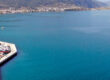


Agios Konstantinos
Agios Konstantinos, today known for its long seafront and port linking mainland Greece with the northern Sporades, stands on a landscape with a much deeper past than its modern appearance suggests. Beneath the coastal roads and beaches lie the remains of Dafnountas, the ancient Lokrian city that once guarded the western flank of Opountian Lokris, serving as both a strategic harbour and a religious centre of considerable importance.
Ancient Dafnountas – A Maritime Outpost of the Lokrians
In antiquity, this stretch of coast belonged to the Eastern Lokrians, a Greek tribal group who controlled the narrow band of land between Mount Kallidromo and the Maliakos Gulf. Dafnountas was one of their key cities, mentioned by geographers and travellers as the coastal link of the Lokrian interior. Its location allowed the settlement to operate as a natural harbour, providing access to sea routes across the gulf and toward Euboea.
Archaeological remains on the slopes above today’s town, particularly in the district known as Isiomata, reveal the outline of ancient fortifications—long walls that once defended the settlement and supervised movement along the coastal route. Pottery fragments, coins, and domestic debris show continuous activity from the Classical period (5th–4th centuries BC) through the Hellenistic and into the Roman era. The pattern is typical of many Lokrian towns: modest in size, but consistently occupied, strongly tied to regional trade, and organised around both civic and religious spaces.
The Sanctuary of Asclepius
The most remarkable discovery in the Agios Konstantinos area is the presence of a substantial Asclepieion—a sanctuary dedicated to Asclepius, the god of healing. Built on a hillside terrace with commanding views over the gulf, it followed the typical layout of healing sanctuaries: stoas for patients, rooms for ritual incubation, and open spaces for votive activity. Excavations revealed marble and terracotta figurines, pottery connected with ritual cleansing and offerings, and fragments of statuary used in healing rites.
The Asclepieion of Dafnountas is among the best-preserved and well-documented Asclepieia of Central Greece, providing important evidence for how smaller Greek communities practiced ritual healing outside the major centres such as Epidaurus. The sanctuary’s long lifespan—active from Classical times through the Roman period—reflects a continuity of cult practices and a steady inflow of worshippers seeking divine assistance for ailments. During Roman rule, when healing cults flourished, Dafnountas’ sanctuary appears to have experienced renewed attention and reconstruction.
Burials and Everyday Life Around the Ancient Town
The slopes above modern Agios Konstantinos have also yielded tombs and funerary structures, including a Roman vaulted grave. Such finds indicate that the community extended beyond the immediate coast, with residential, religious, and burial zones laid out across the hillside. Everyday objects—lamps, domestic pottery, tools—paint a picture of a modest but stable town closely tied to the rhythms of the sea.
Earthquakes, coastal changes, and sedimentation gradually altered the ancient shoreline. Parts of the historic harbour may now lie inland or beneath today’s beach, a common phenomenon along the Maliakos Gulf. Despite these changes, the archaeological record preserves clear testimony to Dafnountas’ role as a coastal outpost and sanctuary centre within the Lokrian world.
Byzantine and Early Modern Periods
After antiquity, the region remained inhabited, though with shifting population patterns typical of rural Greece. The most distinctive event of this later era was the discovery in 1832 of a Byzantine-era icon of Saints Constantine and Helen in the area known as Grados. Its appearance inspired the naming of the new settlement: Agios Konstantinos. The village grew as a local fishing and agricultural community, and the church that soon rose to house the icon became the spiritual nucleus of the town.
The 1894 Earthquake and Modern Reconstruction
A major turning point came with the earthquake of 1894, one of the strongest in Greek history. Agios Konstantinos suffered severe destruction; contemporary accounts describe houses collapsing or even sliding into the sea. The reconstruction that followed introduced a more planned settlement layout, including wider streets and a more open coastal frontage.
In the mid-20th century, with the construction of the Athens–Thessaloniki national road, Agios Konstantinos evolved into a convenient stopover and eventually a small resort. The development of its port as a departure point for the northern Sporades further solidified its role as a gateway town. Despite modernisation, the traces of ancient Dafnountas remain visible in the landscape—quiet reminders of a far older identity beneath the seaside atmosphere.
Sights
Ancient Asclepieion of Dafnountas (Isiomata)
On the hillside east of the town; foundations, terraces, and architectural remains of the ancient healing sanctuary. An atmospheric site with panoramic views.
Ancient Fortification Walls of Dafnountas
Scattered wall segments and defensive structures around the Isiomata area, marking the outline of the Classical–Hellenistic town.
Archaeological Museum of Lamia
Houses finds from the Dafnountas excavations, including votive figurines, pottery, and other artefacts from the Asclepieion.
Vromolimni Wetland
A coastal wetland just east of town, important for birdlife and ecological history; offers a good sense of the region’s natural landscape.
Kammena Vourla
Thermal springs and historic spa town just a few kilometres west; long history of therapeutic use dating back to antiquity.